To bevel a plate for welding, take the bevel angle and root face from the welding procedure, then cut the edge with a method that holds both along the full length. Grinding and torch cutting depend on the operator’s hand. A plate beveling machine mills the angle mechanically, so every edge matches the drawing.
Why plate bevels cause trouble at fit-up
Welding forums keep returning to the same problems. A grinder bevel drifts off angle along a long edge. An uneven root face leads to burn-through or lack of fusion in the root pass. A torch-cut bevel leaves oxide and a heat-affected zone that has to be ground away, and on stainless steel extra grinding adds heat and contamination risk. Every one of these costs fit-up time before the first weld pass.
Table 1 – Bevel preparation methods compared
| Method | Angle consistency | Root face | Heat into edge | Cleanup before welding |
|---|---|---|---|---|
| Angle grinder | Operator dependent | Hard to keep even | Low, local | Finishing as needed |
| Flame or plasma | Depends on setup | Often needs grinding | High, heat-affected zone | Remove oxide and dross |
| Plate edge milling machine | Set on the machine | Set on the machine | None – cold milling | Clean per WPS |
How our plate edge milling machines solve it
As a manufacturer of plate bevelling machines in Shanghai, we build two formats for this job. The GMMA-63L walking plate edge milling machine clamps onto the plate and travels along the edge, cutting 0-90 degree bevels on 6-60 mm plate, including V, Y, X/K, U/J and L joints. For batches of smaller parts, our TMM-S20T and TMM-S30T stationary edge milling machines clamp the plate on a table and feed it past the cutter.
Both formats cold-mill the edge with carbide inserts, so the bevel face is machined with no oxide layer from thermal cutting. Angle and root face are set on the machine rather than by hand, which keeps a long edge consistent from start to finish. We supply factory direct, with 380 V 50 Hz as standard and other voltages built to order.
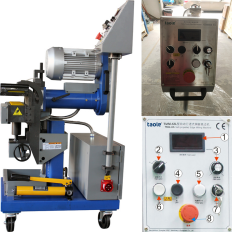
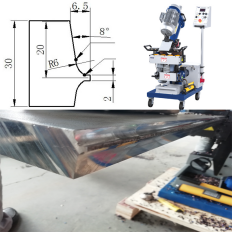
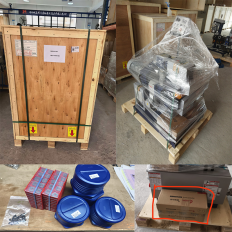
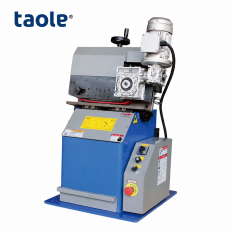
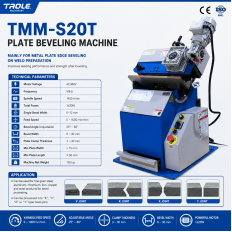
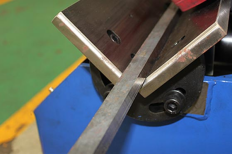
Table 2 – Configuration of TAOLE plate beveling machines
| Parameter | TMM-S20T | TMM-S30T | GMMA-63L |
|---|---|---|---|
| Format | Stationary table | Stationary table | Walking, self-propelled |
| Clamp thickness | 3-30 mm | 8-80 mm | 6-60 mm |
| Bevel angle | 25-80 deg | 10-75 deg | 0-90 deg |
| Single-pass / max bevel width | 0-12 / 0-25 mm | 0-20 / 0-70 mm | 0-20 / 0-60 mm |
| Total power | 1620 W | 4520 W | 4520 W |
| Feed speed | 0-1000 mm/min | 0-1500 mm/min | 0-1500 mm/min |
| Bevel joints | V, Y | V, Y | V, Y, X/K, U/J, L, clad removal |
| Net weight | 155 kg | 850 kg | 225 kg |
| Product page | View model | View model | View model |
Buyer FAQ
What is a plate beveler?
A plate beveler, also called a plate bevelling machine or plate edge milling machine, cuts a weld-preparation bevel on a plate edge. Milling types use a rotating cutter with carbide inserts and set the angle mechanically.
Which tool keeps a bevel angle consistent on long plates?
A walking plate edge milling machine. It clamps to the edge and travels at a fixed angle setting. Our GMMA-63L covers 0-90 degrees on 6-60 mm plate.
Can one machine bevel thick plate?
Yes, in passes. The GMMA-63L lists a 60 mm maximum bevel width at up to 20 mm per pass. For thick parts in batches, the TMM-S30T table machine clamps 8-80 mm plate.
Request a model recommendation
Replacing grinder bevels or planning a new fabrication line? Send us your plate thickness, plate size, material and joint drawing. Our engineers will recommend a model, state the number of passes for your bevel and quote factory direct.
Post time: Nov-09-2026