During pipeline shutdowns, the equipment must often be installed around an existing pipe rather than over an open end. A split-frame pipe Chamfering machine separates into two halves, clamps around the pipe OD and machines the circumference in place. This arrangement supports cold cutting, beveling, facing and weld-end preparation while limiting the additional dismantling required for fixed pipelines, fittings and constrained work zones.
What Should Buyers Verify Before a Shutdown Cut
|
Site Input |
Why It Matters |
Acceptance Check |
Buyer Requirement |
|
Actual pipe OD |
Determines whether the split frame can clamp concentrically. | Measure OD at several points. | Confirm 300-457 mm working range. |
|
Wall and material |
Controls tool load, feed and cutter selection. | Test the thickest specified pipe grade. | Provide wall, hardness and material. |
|
Clearance |
Frame and drive need radial and axial access. | Make a site clearance sketch. | Check valves, supports and nearby pipe. |
|
Joint profile |
Cut, bevel, land and counterbore affect tooling. | Inspect a sample against the WPS. | Send angle, root face and finish criteria. |
Electric and Pneumatic Model Comparison
|
Model |
Drive |
Pipe OD |
Speed |
Energy Input |
Wall Capacity |
Best Site Fit |
|||
|
Electric |
300-457 mm |
12 r/min |
1.8/2.0 kW |
30 mm std; 110 mm HD |
Reliable site power | ||||
|
Pneumatic |
300-457 mm |
12 r/min |
0.6-1.0 MPa; 1800 L/min |
Up to 35 mm |
Compressed-air sites | ||||
|
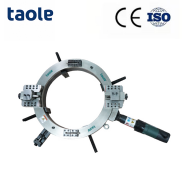
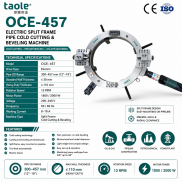
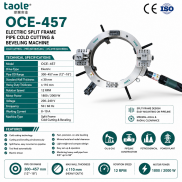
OCE-457 |
 |
 |
https://www.bevellingmachines.com/electric-split-frame-pipe-cutting-and-beveling-machine-oce-457.html | ||||||
|
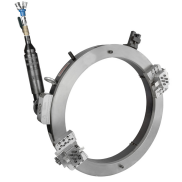
OCP-457 |
 |
 |
https://www.bevellingmachines.com/split-frame-clamshell-cold-tube-cutter-ocp-457.html | ||||||
The OCE-457 and OCP-457 share the same 300-457 mm OD class and 12 r/min nominal rotation speed, but their utilities differ. The electric split frame pipe cutting and beveling machine suits sites with stable 200-240 V power and offers standard and heavy-duty wall configurations. The pneumatic clamshell pipe cutter is appropriate where plant air is preferred, but the buyer must verify pressure and flow at the machine under load, not only compressor nameplate output.
A key productivity advantage is the ability to perform simultaneous cutting and beveling with suitable tool slides. That can reduce separate handling between pipe severing and weld preparation. Procurement teams should still treat cold cutting as a controlled machining process: isolate and support the pipe, confirm the work permit, protect personnel from chips, and verify frame alignment before starting. The machine specification does not replace the site risk assessment.
Buyer FAQs
|
Procurement Question |
Short Answer |
| When should buyers choose the electric model? | Select OCE-457 when dependable site power is available and electric-drive simplicity is preferred. |
| When is the pneumatic model more suitable? | Select OCP-457 where compressed air is required; verify pressure and 1800 L/min flow at working load. |
| What should be sent with the inquiry? | Provide actual OD, wall, material, joint drawing, clearance, site utility and whether cutting and beveling must be simultaneous. |
Post time: Oct-15-2026