A remote-control Plate Chamfering Machine addresses a practical fabrication concern: operators need clear visibility of the bevel while avoiding unnecessary proximity to the moving cutter, hot chips and a traveling machine. Remote operation does not replace guarding or procedures, but it can improve supervision and reduce repeated walking beside long plates. For buyers processing stainless steel or heavy sections, the key value is combining controlled movement with cold milling and repeatable weld preparation.
What Should Buyers Verify About Remote Operation
|
Control Point |
Operational Value |
Verification Test |
Buyer Requirement |
|
Control range |
Lets the operator choose a safer viewing position. | Test signal stability around the full plate. | Confirm rated range and interference limits. |
|
Start and stop |
Supports timely control during setup and cutting. | Check response under normal production load. | Confirm emergency-stop arrangement. |
|
Travel control |
Helps supervise feed along long plate edges. | Run a full-length sample without interruption. | Record feed speed and edge straightness. |
|
Visibility |
Improves monitoring of chips, clamping and cutter path. | Review sightlines from the intended station. | Define barriers and operator position. |
Remote Control Model Comparison
|
Model |
Plate |
Angle |
Max Width |
Feed |
Power |
Recommended Work |
|||
|
6-80 mm |
0-60 deg |
70 mm |
0-1500 |
4.92 kW |
Heavy plate and stainless steel | ||||
|
6-60 mm |
0-90 deg |
60 mm |
0-1500 |
4.52 kW |
U J bevels and clad removal | ||||
|
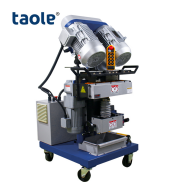
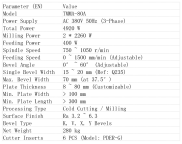
GMMA-80AY |
 |
 |
https://www.bevellingmachines.com/gmma-80ay-remote-control-plate-beveling-machine-for-stainless-steel-plates.html | ||||||
|
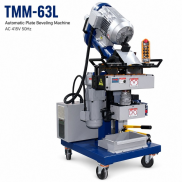
GMMA-60LY |
 |
 |
https://www.bevellingmachines.com/gmma-60ly-remote-control-plate-edge-milling-machine.html | ||||||
Both models are remote control plate beveling machines with automatic walking, adjustable feed and automatic clamping. The GMMA-80AY covers thicker plate up to 80 mm and a 70 mm maximum bevel width, making it the heavier-capacity choice for carbon steel, stainless steel and alloy plate. The GMMA-60LY extends the angle range to 90 degrees and supports V, Y, X, K, U and J profiles, L beveling and clad removal. Published feed capacity reaches 1500 mm/min, while the milled finish is Ra 3.2-6.3 without an oxide layer. Actual productivity still depends on material grade, bevel depth, insert condition and the number of passes.
Remote control is therefore a risk-reduction and workflow feature, not a substitute for guarding. Before acceptance, the buyer should witness a full-length sample, verify automatic clamping, confirm the remote response and inspect bevel angle, land, surface finish and chip handling. A test on the buyer’s stainless or alloy plate gives more reliable evidence than a no-load demonstration.
Buyer FAQs
|
Procurement Question |
Short Answer |
| Which model suits thicker stainless steel plate? | GMMA-80AY covers 6-80 mm plate and up to 70 mm bevel width; confirm the required pass plan by sample test. |
| When should buyers select GMMA-60LY? | Choose it when 0-90 degree adjustment, U or J bevels, L beveling or clad removal is required. |
| What should be included in the purchase specification? | State material, thickness, plate length, joint drawing, finish target, voltage, remote-control requirements and acceptance test. |
Post time: Oct-15-2026