When Should Fabricators Use U and J Bevels Instead of V Bevels
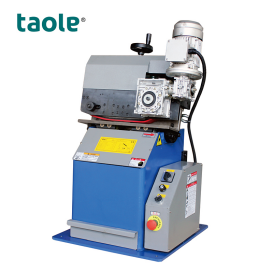
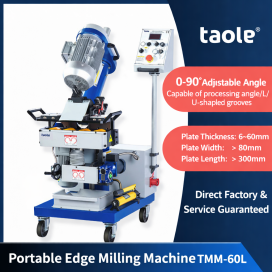
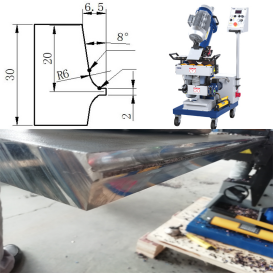
The correct Steel Plate Beveling machine must match the groove specified by the welding procedure, not only the plate thickness. V and Y bevels are straightforward for general fabrication, while U and J profiles can reduce groove volume on heavy joints but require controlled radii, root faces and tool positioning. A plate edge milling machine using cold cutting can produce a weld-ready surface without thermal oxidation or secondary flame-cut cleanup.
How Groove Geometry Changes the Purchase Decision
| Groove Need |
Machine Requirement |
Production Risk |
Buyer Check |
| V or Y bevel |
Adjustable angle and consistent land. |
Excess width increases weld volume. |
Send angle, land and bevel width. |
| U or J bevel |
Dedicated profile tooling and controlled radius. |
Wrong radius can affect root access. |
Provide a dimensioned joint drawing. |
| 90 degree milling |
Rigid spindle adjustment and stable clamping. |
Poor support can cause edge variation. |
Confirm plate support and clearance. |
| Clad removal |
Controlled depth without damaging base plate. |
Overcut changes remaining thickness. |
Specify clad grade and removal depth. |
Machine Capability Comparison
| Model |
Plate |
Angle |
Max Width |
Feed |
Power |
Recommended Use |
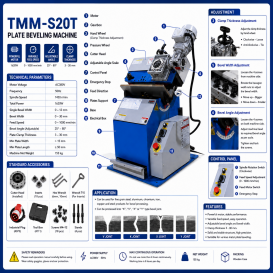
| TMM-S20T |
3-30 mm |
25-80 deg |
25 mm |
0-1000 |
1.62 kW |
Repeated V and Y bevels |
| TMM-S30T |
8-80 mm |
10-75 deg |
70 mm |
0-1500 |
4.52 kW |
Heavy V and Y bevels |
| GMMA-63L |
6-60 mm |
0-90 deg |
60 mm |
0-1500 |
4.52 kW |
U J L bevels and clad removal |
The stationary TMM-S20T and TMM-S30T support continuous feeding for repeated V and Y bevels. S20T targets thinner and smaller parts, while S30T reaches 80 mm plate thickness and a 70 mm maximum bevel width. The self-propelled GMMA-63L travels along the plate edge and expands the process range to 0-90 degrees, U, J and L profiles, clad removal and vertical milling. Published performance includes automatic clamping, 0-1500 mm/min feed and Ra 3.2-6.3 surface finish.
For thick-plate procurement, the drawing must define more than an angle. Buyers should state the groove radius, root face, transition dimensions, material grade and allowable surface finish. A sample cut should be checked with a profile gauge or approved template. This prevents a common sourcing mistake: purchasing enough motor power and bevel width, but not confirming that the cutter system can reproduce the required U or J geometry.
| Procurement Question |
Short Answer |
| Which machine is suitable for U and J bevels? |
GMMA-63L supports U and J profiles; buyers should submit the exact radius, land and transition drawing. |
| When is a stationary model more practical? |
Use S20T or S30T for repeated V or Y bevels on parts suited to continuous table feeding. |
| What should be confirmed before purchase? |
Verify material, thickness, joint profile, bevel width, feed direction, voltage, tooling and sample acceptance criteria. |
Post time: Oct-19-2026